





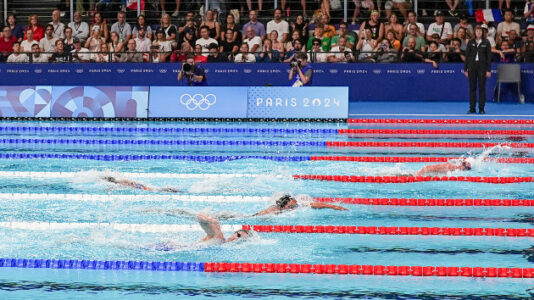
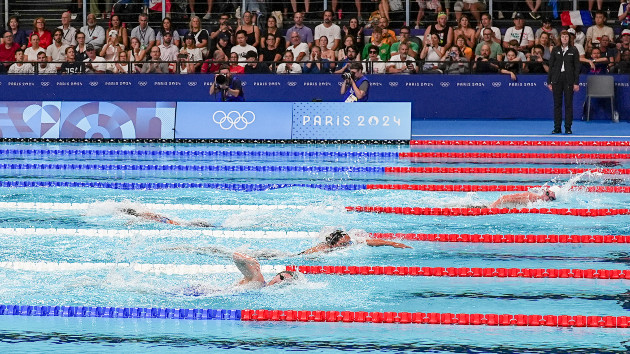
(NEW YORK) — Three former world record holders, Australia’s Ariarne Titmus, USA’s Katie Ledecky, and Canada’s Summer McIntosh fell well short of their best times in the women’s 400 freestyle event at the 2024 Paris Olympics on Saturday.
In contrast, none of the eight swimmers in the men’s competition on Sunday would have finished better than eighth at the 2021 Tokyo Olympics.
World-class swimmers rarely get slower in their prime and technology constantly improves, so why aren’t we seeing records drop like usual? Can a pool really be responsible for slowing down the swimmers?
Jud Ready, a professor at Georgia Tech’s School of Material Science and Engineering, teaches a class on engineering in sports and says a pool can be slow. He spoke with ABC News’ “Start Here” about the difference in this 2024 Olympics pool compared to others.
Ready and his alma mater, Georgia Tech, know about pools. The school hosted swimming competitions in the Atlanta 1996 Games and still boasts the so-called “fastest pool in the country.”
So what makes a pool fast? According to Ready, pool engineers obsess over keeping the water calm.
“You want to not have the other swimmers impact each other,” Ready said. “So any sort of waves or wake or splashing or anything like that, you want that to not impact the body next to you.”
When you’re dog paddling, a few splashes might not make a big difference. However, elite swimmers create waves when they thrash. Some swimmers describe riding the wake of others around them. Some of those waves travel downward, and as they bounce back up, it’s like swimming through ever-so-choppy water.
And the depth of the pool plays a critical role, Ready says.
Wel ;
Even that swim had been postponed from when it was originally scheduled to take place in June but river samples at the time were deemed to be too unhealthy for her to swim in.
During heavy rains, sewage can overflow into the river. For example, on June 18, after several days of rain, E. coli levels in the Seine River jumped to roughly 10,000 Colony Forming Units per milliliter, more than 10 times the safety limit.
According to findings published by Paris City Hall earlier this month, the last week of June saw four days when the water was clean enough to swim in, according to European standards, but no days when it was clean enough to swim in according to U.S. standards.
Paris Olympics officials initially insisted there would be “no plan B,” but organizers revealed their contingency plans on July 5, saying that open-water swimming might take place in the Marne River instead. In addition, officials said they could delay the triathlon event or, in the worst-case scenario, eliminate the swimming portion of the competition altogether.
Copyright © 2024, ABC Audio. All rights reserved.