




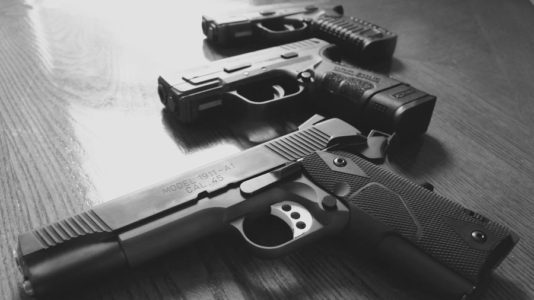
The world is a scary place. With crime becoming a major problem throughout the country, a lot of people are concerned for their personal safety. So, more and more people are choosing to concealed carry a firearm for defense of themselves and their loved ones. In the past, it has been difficult or inconvenient for many to be able to carry a handgun legally. Fortunately, in the state of Utah, our legislature saw fit to enact constitutional carry policies, meaning that now everyone over the age of 21 who wants to carry a firearm for personal protection can, regardless of whether or not they obtain a concealed carry permit. But, there still remains one problem: what’s the best gun to carry for self defense? With a little luck, this article will hopefully shine some light on what the best choice is when it comes to concealed carry.
Semi-Auto or Revolver?
For the purpose of this article, we’ll be specifically looking at handguns, as a vast majority of people who carry will not be hiding a full sized rifle or folding carbine under their coat. There are a plethora of brands and models to choose from in the handgun world. The first question you should ask yourself is if you want to go with a semi-auto handgun or a revolver (there are other fringe options such as derringers, but these are the two we’ll focus on today) . Both have their own benefits and detriments, so it really depends on what your needs are. If you decide on a semi-automatic, you generally have more options to choose from in terms of models and calibers. Semi-autos also tend to have higher bullet capacities due to the use of a magazine rather than the revolver cylinder, but with some sub-compact models it often will only be one or two extra rounds. A revolver is a classic, but you are limited in terms of available calibers, as well as capacity. However, a compact snub-nose revolver can be more concealable than a lot of semi-auto pistols. Revolvers are also popular among women do their typically smaller handles and the lack of a need to rack the slide.
Once you’ve decided whether you want a pistol or a revolver, you need to choose a caliber. Bullets come in all shapes and sizes, so you’ve got quite a few options. The following are the most common options for handgun calibers:
Semi-Auto Pistol Calibers
9mm Luger is the most common handgun caliber in America, and for good reason. This .38” projectile is no slouch when it comes to stopping power, especially when using hollow point ammunition. But, it does have its drawbacks. The bullets are not overly heavy in terms of projectile weight, meaning that they don’t pack quite the same punch as some other options. But, with an average 1300 feet-per-second muzzle velocity, what it lacks in heft it makes up for in speed. The recoil is manageable for most people, even in sub-compact handguns, but can be a little much for more inexperienced shooters or those with slender builds. That, combined with the relatively low cost and high availability of ammo, makes 9mm an extremely attractive option for a majority of shooters.
If the 9mm recoil is a little much, or if you feel that the guns that come in it are a little bulky, 380 Auto has your back. Developed by the legendary John Browning (a Utah native, I might add), there’s nothing better for those who feel they want something a little more sleek than 9mm. With extremely low recoil, 380 is a great option for women or new carriers who don’t shoot often. However, it has relatively low muzzle velocity and lower projectile weight than many other options, meaning that it lacks stopping power in a variety of situations. But, bullets always hurt, so if this is the caliber for you, rest assured it will more than likely get the job done.
For those who want maximum stopping power and some extra kick, .45 ACP is the best choice. Another Browning cartridge, the .45 was made to go in the legendary 1911, the state firearm of Utah. Boasting heavy projectiles and almost as much muzzle velocity as 9mm, the .45 has your back for a lot of situations. However, be warned that with extra power come extra recoil, or a larger package. A lot of weapons chambered in .45 ACP tend to be bigger and bulkier, making them harder to conceal (but not impossible).
Some less common calibers include .40 S&W, 10mm Auto, and .357 Sig. All of these have their own pros and cons, but because they lack the widespread use of the three above, we won’t be discussing them in this article. I do however encourage you to do your own research, as they may be the right ones for you (especially if you need protection from bears instead of people).
Revolver Calibers
As previously mentioned, revolvers are a little more limited in selection. The most common calibers for concealed carry are .38 Special, .357 Magnum, and .44 Magnum. .38 Special is the “weakest” of the three, but still no slouch. It is a relatively low-recoiling caliber, and is a favorite among women and those just starting out. It also has the benefit of being fireable in any .357 Magnum chamber (though the inverse is not true), making it a popular practice caliber for those who do carry .357 revolvers. Speaking of, the .357 Magnum packs a heavy punch on the target, but also on your wrists and ears. In a barrel less than 6” in length, you don’t get a ton more performance out of .357 when compared to .38 either. However, for those comfortable with it, the .357 Magnum can be a real powerhouse in terms of stopping power. If .357 was hard on your body, then .44 Magnum is gonna rock your world. Boasting the most energy on target of the three calibers mentioned, .44 will be sure to stop whatever it hits in its tracks. But, in this case, big things come in big packages, and .44 Magnum revolvers tend to be very large and hard to conceal.
If you’re really dead set on going big or going home, there are other revolver options including .454 Casull and 500 S&W Magnum/Special, but these are a little large for a majority of concealed carriers, so we’ll leave them out for today
Weapon Options
Now that we’ve decided on what kind of handgun we want, and what caliber we’re after, it’s finally time to pick a gun. There are many brands to choose from. In the states, the three most common are Glock, Smith and Wesson, and Sig Sauer for semi autos, and Taurus/S&W for revolvers. Glocks are easy to handle, easy to shoot, and, for the most part, easy to conceal. The Glock 42 (380 ACP), 43, and 43X (both 9mm), are fantastic options when it comes to concealed carry. Glocks are a favorite among law enforcement for their supreme reliability. However, the lack of an external safety is an issue for a lot of folks, so keep that in mind. The Smith and Wesson M&P Shield is a rising favorite in the United States, and for good reason. The Shield Series features some extremely compact firearms, making them extraordinarily easy to conceal. They also have the benefit of being an American company, unlike the Austrian Glock. S&W’s Airweight series of revolvers are also some of the best in the field, being light and compact, but often lacking an external hammer, forcing users into the heavy trigger pull of a double-action revolver. While we’re here. Taurus is owned by Smith & Wesson, and is a generally cheaper option than the Airweight series. The Taurus model 850 or the model 856 make great concealed carry revolvers. Finally, the Sig Sauer p365 is a fantastic option for 9mm users. It features a relatively large magazine capacity for its size and is a reliable option with a pleasant trigger pull, but it does tend to be a little snappy on the recoil, so just be ready.
If you can conceal them, the Glock 19 and any 1911s are also great options. The Glock 19 is a little bit bigger than the previously mentioned models, but also has a larger magazine capacity and is still concealable under a hoodie or a jacket fairly easily. The 1911 is a classic, and a favorite among service members for its legendary reliability and use in both World Wars. This .45 ACP handgun has a lower mag capacity and considerable bulk, but makes up for it in stopping power and style.
Conclusion
Ultimately, the choice is yours on what you carry, should you choose to pack a gun for self defense. What is most important is that you are comfortable with your weapon. Practice is paramount, whether that means you go to the range often or dry practice for 10 minutes before bed. Hopefully this article shed some light on what’s out there, and helped those of you looking for an entry point into the concealed carry world find a starting place. Stay tuned to MidUtahRadio.com for more on outdoors and firearms related topics, as well as local news and sports for Central Utah. And in the words of CW McCall, “keep the bugs of your glass and the bears off your . . . tail.”