






The 1911 is perhaps one of the greatest handguns ever designed. Originally created by John Browning, this legendary firearm has seen service in two world wars and several smaller conflicts, and is still in service in the US military over 100 years after it was first adopted. But, that hasn’t stopped people from trying to improve on Browning’s design. With the turn of the 21st century came the advent of the 2011, a modernized version of the classic Colt handgun. The Springfield Armory 2011 variant is called the Prodigy, and it’s been all the rage over the last year-and-a-half since its release. I happen to have acquired this new handgun, and today I’ll tell you if it was worth the money and the hype.
Disclosure
Before we get too far into the weeds, I should mention that I have been in no way endorsed by Springfield Armory. I purchased the Prodigy with my own money, bought my own ammo, and tested the weapon on my own time. So, there should be no external bias in my review.
Overview
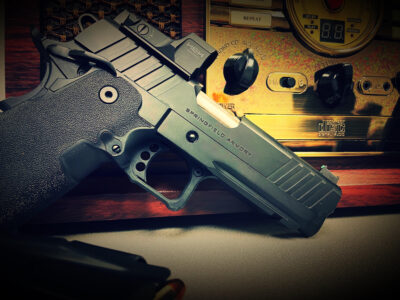
The Springfield 1911 DS Prodigy is, for the most part, a standard 2011. My version features the 4.5 inch barrel, and is chambered in 9mm. It has a fiber optic front sight, notched rear sight, and the Hex Dragonfly red dot sight that came with the handgun. The slide and frame are both carbon steel with a black cerakote. The grips are polymer. There are two safeties, as with any 1911, one manual thumb safety and one grip safety. The Prodigy comes with two magazines, one that holds 17 rounds and one that has a 20 round capacity, though Springfield does sell a 26 round extended magazine.
Pros
There are many things I like about the Prodigy. First off, it’s just a very cool looking handgun. The all black cerakote and slide cutouts make it a very aesthetically pleasing weapon. Secondly, the change from 45 ACP to 9mm Luger helps to reduce recoil. That, combined with the super smooth slide and improved 1911 straight pull trigger, make the Prodigy an extremely pleasant weapon to shoot. The polymer grips are quite comfortable to hold, and the grip safe is smooth and, to be honest, it’s hardly noticeable when firing the Prodigy. If you’re someone who prefers iron sights, the green fiber optic front sight is easy to line up. If you’d rather the red dot sight, the Hex Dragonfly is certainly not a bad option. While there are better red dots out there, the Dragonfly works well, has adjustable brightness, holds zero well, and is all around a pretty good optic. Springfield also makes it quite easy to swap out the optic-ready plate and the regular rear sight, so you could go back and forth to decide which you liked better. The gun cycles smoothly, and I have yet to have a jam in the probably 200 rounds I have through it. Additionally, the Prodigy does have a rail on the front for attaching a flashlight or laser, which is nice if you like to have a weapon light. It should also be mentioned that 9mm is a much more common, easy to find, and less expensive caliber than .45.
Cons
There are some drawbacks to the Prodigy. First of all, it’s most definitely a full sized handgun, meaning it’s very hard to concealed carry. It is a little bit bulky, so it would show through most attempts at concealment, so it’s certainly not an every-day carry gun. Also, coming in at a little over 2 lbs, the Prodigy is a little heavy compared to other handgun options. Secondly, obviously 9mm lacks the raw stopping power that’s so popular with the traditional 1911 chambering of .45 ACP. However, I think the added magazine capacity (17 at base compared to the 1911’s standard 7) makes up for that. Finally, the Prodigy is quite expensive for a handgun. The least expensive model has an MSRP of about $1,500, making the Prodigy much less affordable than a lot of 1911s or other full sized handguns.
Conclusions
Full disclosure, I love the Springfield Prodigy, I’ve been super impressed with the handgun as a whole. It’s pleasant to shoot, runs well, and is really everything one could want out of a 2011. While not quite as nice as some of the higher end 2011s like Staccatos or Nighthawks, it also doesn’t come with quite as high a price tag. As previously stated, it being in 9mm is also a huge plus in my book, as it’s relatively cheap and easy to come by. Overall, I’m quite happy with my Prodigy.
For more articles like this, stay tuned to the Outdoor Corner on MidUtahRadio.com.